gbrain docs · Harness
Updated 2026-07-26
Fork your brain for a group
Snapshot it into a separate brain, give a team access to that one, throw it away when you are done. Your brain never changes.
Your brain grows as you work. At some point a group needs what is in it: a team picking up a project, a diligence process, an onboarding week.
Fork it. We snapshot your brain into a separate one, you give that group access to the fork, and they work in it for as long as the work lasts. When it is over, shut it down.
Your brain is not involved at any point after the snapshot.
The fork is a real separation
The fork is a second brain with its own workspace, its own access list, and its own lifetime.
Nothing the group does reaches back. They can ask it anything, correct it, fill it with their own questions, break it outright. Your brain carries on unchanged because it is somewhere else entirely.
That is what makes this safe to hand out. Not a permission setting you have to get right, just a different brain.
Who gets in, and how they sign in
- The workspace is the guest list. Someone is a member of it, or they cannot reach the fork.
- You add people by email. The invitation is bound to that address. Forwarding it lets nobody else in.
- No passwords. They sign in with Google or a link emailed to them.
- You can see who has not accepted. Unopened invitations sit alongside members, so a decline looks different from an unread email.
- Removing someone removes their access. Take them out of the workspace and the fork closes to them.
Everyone in the fork can reach everything in it
This is the part to be deliberate about.
A fork is a snapshot of your brain, not a filtered view of it. There is no per-person scoping inside a brain and no way to hide part of one from someone who has access to it. The boundary is the brain itself.
So the question is never what to strip out. It is who to let in.
Invite people you would be comfortable handing the whole brain to. If a group should see a different set of material, they get their own fork.
It answers from your material, and cites it
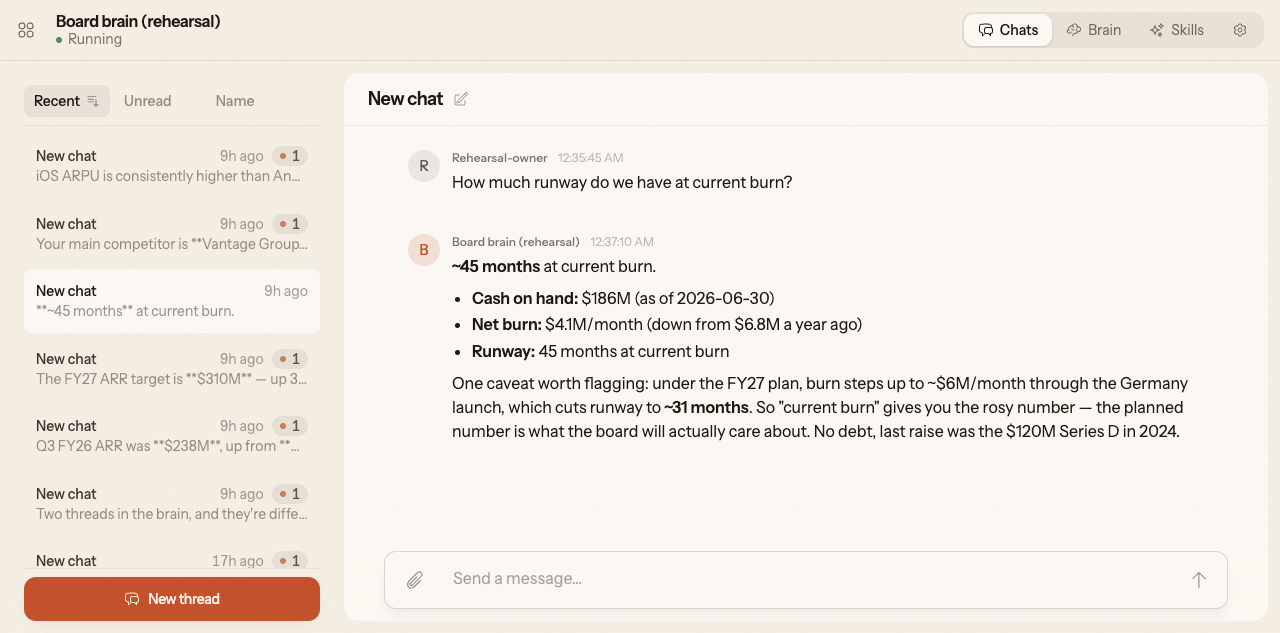
Ask something that spans several documents and it pulls them together.
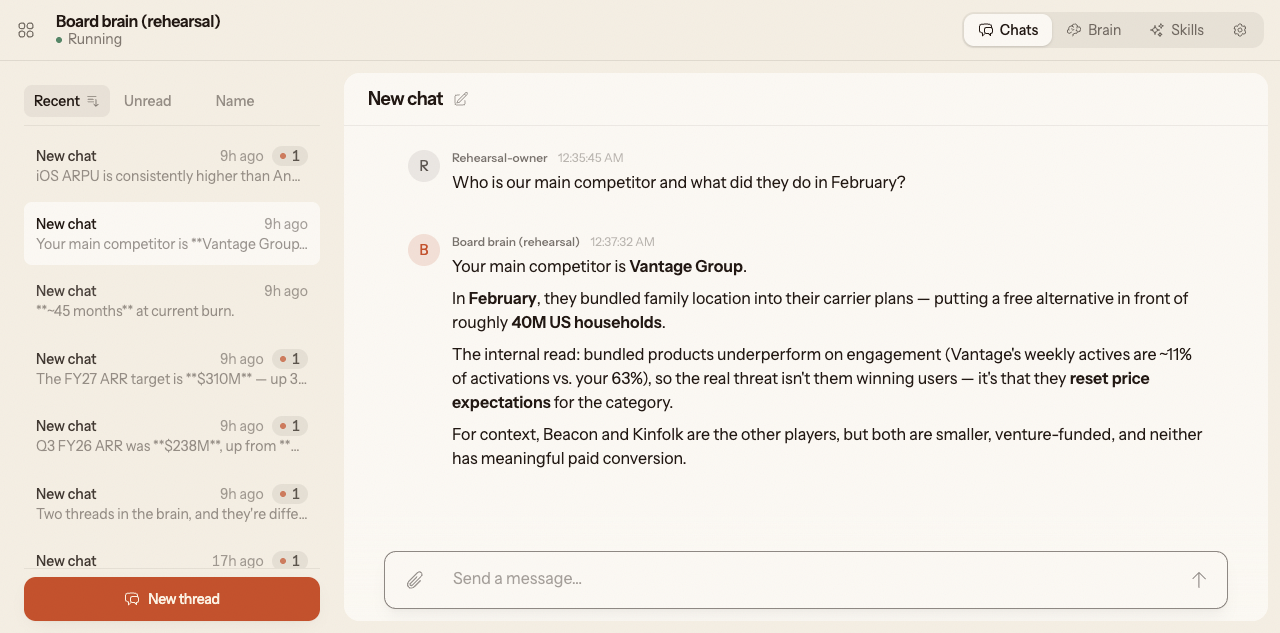
Every question is its own thread, history persists, and questions are attributed to whoever asked them.
Ask it to search, and ask where the answer came from
Two habits worth teaching the group.
- Tell it to look. “Search the brain and tell me our runway” beats “how much runway do we have.” A casual question can get answered from general knowledge rather than your material, and it sounds equally confident either way.
- Ask for the page. An answer it cannot source is an answer you should not repeat.
Rehearse before it matters
Write down the ten or twenty questions the group is most likely to ask, and run every one yourself a few days ahead.
You will learn quickly which topics are sharp and which are thin, with time left to fix the thin ones. Nine good answers and a tenth bad one is worse than knowing in advance where the edges are.
A fork is frozen at the moment you took it
It knows what your brain knew that day. If your brain moves on, the fork does not follow.
For long-running work, take a fresh fork when the material has drifted enough to matter, and tell the group which date they are looking at.
Three ways to end a fork
A fork is disposable by design, so ending one is a choice rather than a cleanup job. Pick whichever fits, or combine them.
Shut it down. Tell us and we freeze or delete it. Access ends with it, and nothing has to be unwound in your own brain because nothing ever happened to it.
Bring back a briefing. Ask the fork to write up what the group worked through, then put that one document into your brain. Usually better than merging raw changes, because a summary written by the brain that did the work is more useful later than a pile of edits.
Merge selected changes back. Review what changed in the fork and pull the pieces worth keeping into your brain, item by item. Nothing moves back on its own, and the review is yours.
Whichever you pick, you also keep the record of every question the group asked, attributed to whoever asked it. That list is often the most useful thing the work produces.
Setting one up
Ask us and we will do it with you. Today this is hands-on rather than a button.
- Tell us which brain to fork and when. The snapshot is taken at that moment.
- We build it. A new workspace and the forked brain inside it.
- We check it. The fork matches your brain, and it answers a real question correctly.
- You send the list of people. They get an emailed invitation and sign in with a link.
Give us a few days before you need it so there is room to rehearse.
What it does not do
- Give the group access to your brain, now or later.
- Hide part of a brain from someone who can reach that brain.
- Update itself when your brain changes.
- Merge anything back on its own.
- Know what was not in your brain when the fork was taken. When it does not know, the right answer from it is to say so.
Questions about setting one up? Reply to any email from us and we will help.