An Obsidian vault is a folder of Markdown notes, so a workspace can take a
copy of it with no export step. Each note becomes a page in Memory, the
vault's folders become folders there, and the workspace answers from the
notes with the note it used.
The copy is a copy, not a connection. Nothing in the vault changes, and a
note written in Obsidian afterwards stays in Obsidian until it is brought in
too.
Two ways in, one place it lands. A vault up to 100 MB goes through a chat. A larger one, or one that keeps changing, is read by Claude Code or Codex on the computer that holds it.
## What comes across
- **Every note, whole**, as one page in Memory under **Sources**, in a
folder named after the vault.
- **The vault's folders**, as folders inside it. Daily notes come across
like any other note, so a question about a day is answered from that
day's note.
- **`[[Links]]` between notes**, as links on the page, under the words
the note gave them. The workspace's AI reads them when it answers.
Opening one from a note in Memory is the exception, below in
[Links between notes](#links-between-notes).
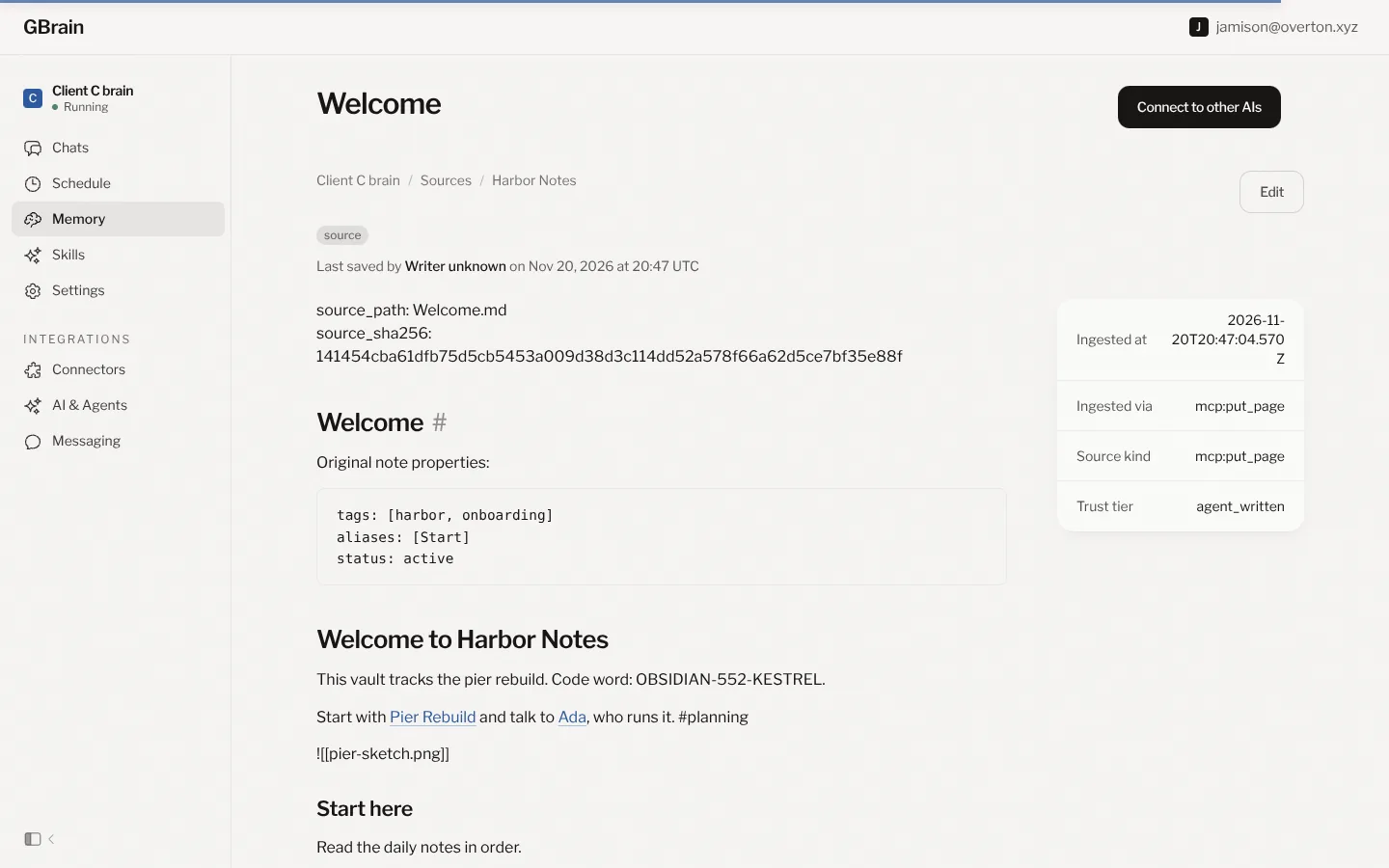
- **Properties**, the block of fields at the top of a note, as text at the
top of its page under "Original note properties". Memory keeps their
words, not its own tags or details for them.
- **`#tags`**, as words in the note. Search finds them; Memory does not
list the note under that tag.
- **Tasks**, as checkboxes, ticked or not as they were.
- **A canvas**, as its text: the words on its cards and the notes it names,
not the drawing.
## Moving it in through a chat
A chat takes a file up to 100 MB. Notes are small, so most of a vault's size
is its pictures and attachments, which do not come across anyway. A vault
over 100 MB fits once it is zipped without its attachments folder.
1. **Zip the vault folder.** On a Mac, right-click the folder in Finder and
choose **Compress**. On Windows, right-click it in File Explorer and
choose **Send to**, then **Compressed (zipped) folder**.
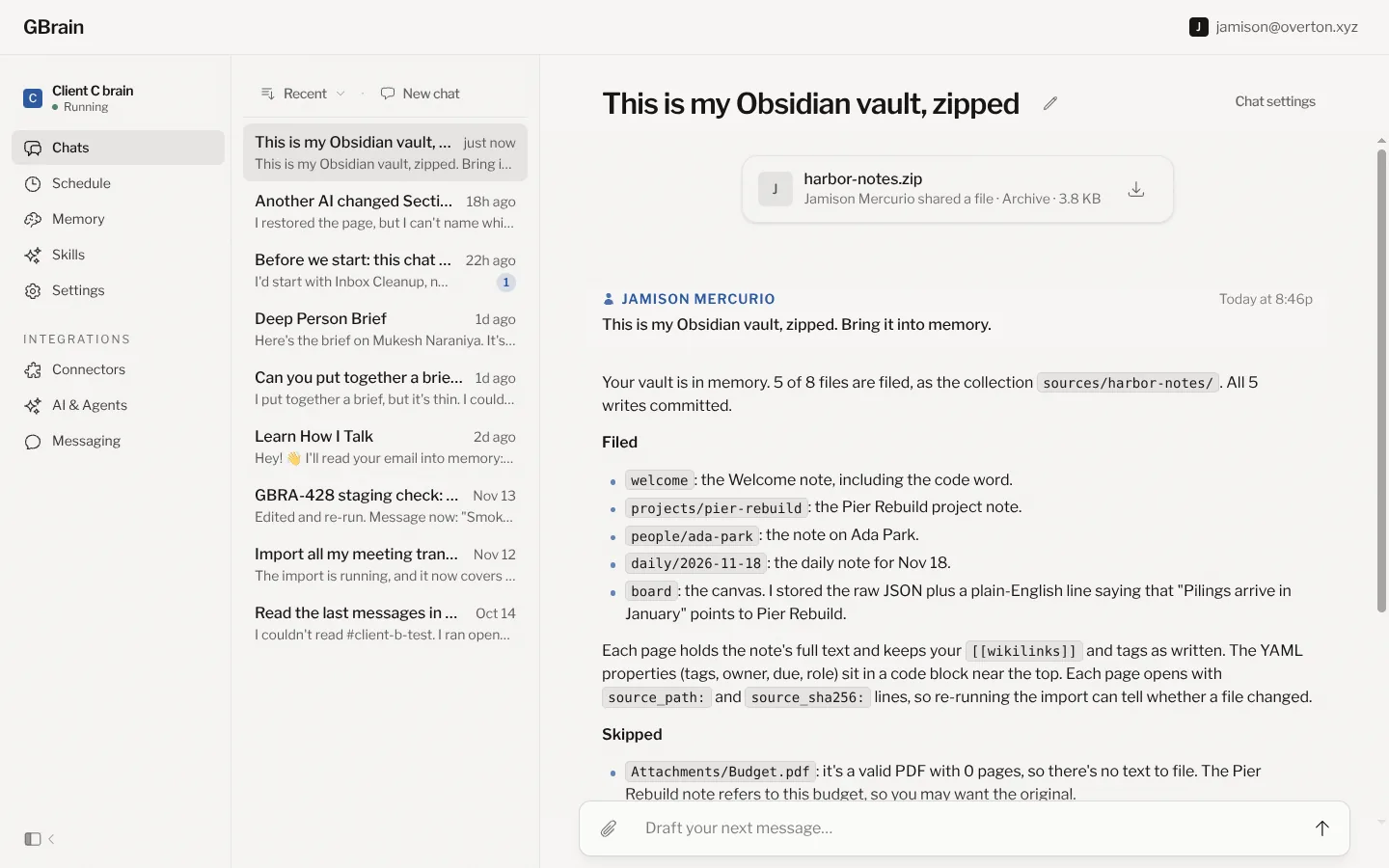
2. **Drop the zip into a chat in the workspace and say what it is:** "This
is my Obsidian vault, zipped. Bring it into memory."
3. **Read the reply.** The workspace unpacks the zip, files each note, and
says what it filed, what it skipped and why. A small vault is in within a
couple of minutes.
A vault of five notes, dropped into a chat. The reply names every note it filed and every file it left out, with the reason.
A zip larger than 100 MB, up to 2 GB, goes through Google Drive instead, with
no terminal: put it in Drive, give the workspace **Drive** at **Read** on
**Connectors**, and ask in a chat to fetch it by name and bring it in.
[Bring a folder of documents into memory](/docs/workspace/bring-in-a-folder#if-you-have-no-ai-of-your-own)
has the steps.
## Moving it in with Claude Code or Codex
Claude Code and Codex read a folder on the computer they run on, with no size
limit, on their own plan rather than the workspace's credit. This is the way
for a very large vault, and for a vault that keeps growing: run it again
later, and it files only the notes that are new or changed.
Follow [Bring a folder of documents into memory](/docs/workspace/bring-in-a-folder):
connect the AI to the workspace with Read & Write, and paste the prompt there
with the vault's folder as the folder and a short name for the collection,
like `harbor-notes`. Add one line to the end of the prompt, "Skip the
.obsidian folder", so the vault's settings are not read as notes. The notes
arrive under **Memory**, then **Sources**, then the collection's name, the same
place a chat puts them.
## Check it worked
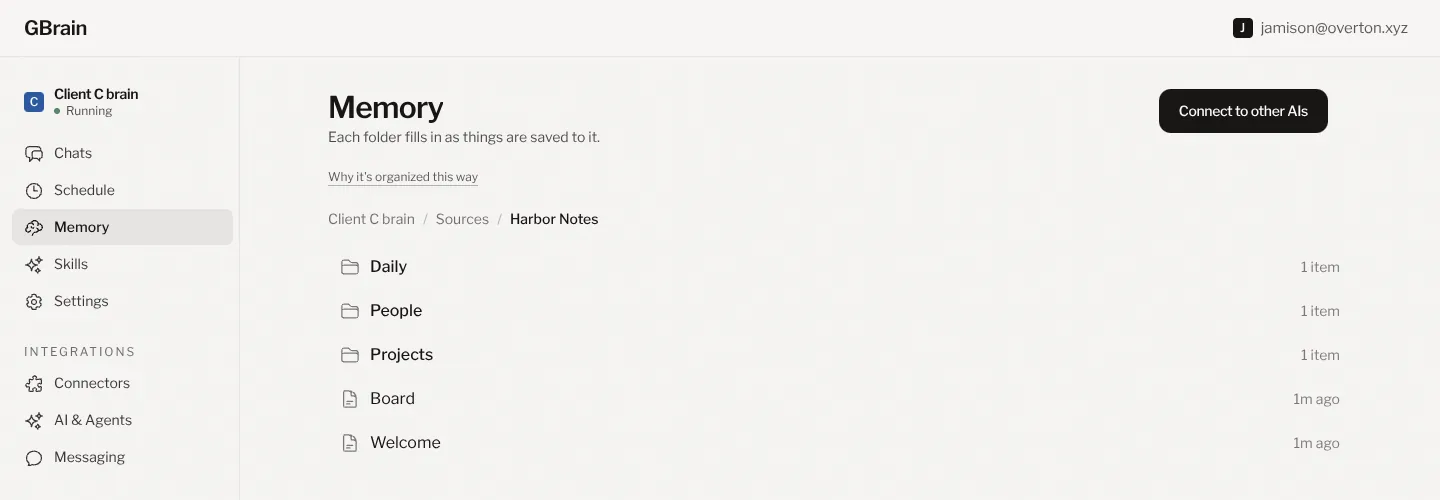
Open **Memory**, then **Sources**, then the vault's name. The vault's folders
are there, and each note opens to its text.
The vault, as it was. Its folders under Sources, and its notes inside them.One note, with its links. The properties sit at the top as text, and the embedded picture stays a line of text.
Then ask the workspace about something only the vault would know, like a line
from last week's daily note. It answers from the notes and names the one it
used.
## Links between notes
A link comes across with its words, and Memory draws it as a link. Obsidian
names the note a link leads to by its title, `[[Pier Rebuild]]`, and
Memory files that note under an address of its own inside the vault's folder.
So opening a link from a note in Memory today leads to a page that says it
could not be read, where it should lead to the note. Open a linked note from
its folder instead, or ask the workspace about it: its AI finds the note by the link's
words.
## What stays behind
- **Pictures and attachments.** Memory holds text, so an image, a PDF or any
other file in the vault is not copied. An embed, `![[sketch.png]]`, stays
in the note as that line of text. A PDF with text in it can be dropped into
a chat on its own, up to ten at a time.
- **Embedded notes.** `![[Another note]]` arrives as that line, not as the
other note's text. The other note comes across on its own page.
- **Callouts**, as quotes, with Obsidian's marker such as `[!note]` left in
as text.
- **What a plugin works out.** A Dataview table, a Tasks query or a chart is
drawn inside Obsidian, so the note keeps the query as written, not its
result.
- **The `.obsidian` folder**: the vault's settings, theme and plugins. It is
left out.
- **A canvas's layout.** Its cards' words come across; where they sit and how
they are joined does not.
The copy in memory does not follow the vault on its own. When the vault has
moved on and the difference matters, bring it in again with Claude Code or
Codex, which files only what is new or changed.